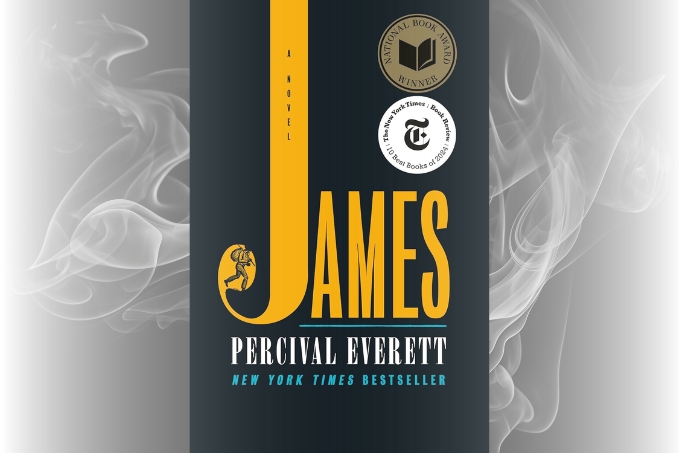

by: Percival Everett
published: March 19, 2024
genre: Historical Fiction
304 Pages, E-Book
Goodreads | Amazon

Synopsis
In James, Percival Everett reimagines Mark Twain’s The Adventures of Huckleberry Finn from the perspective of Jim—a man enslaved by Miss Watson, who makes the bold decision to run away after learning she plans to sell him and separate him from his family. What follows is a powerful, deeply human journey, as Jim travels the Mississippi River in pursuit of freedom and reunion with his family.
But Jim is no passive side character here—he is the beating heart of the story. Smart, self-possessed, and quietly courageous, Jim navigates a brutal world with clarity and purpose. Along his journey, he meets a cast of memorable characters: Norman, a performer who is “passing”; Sammy, a young enslaved girl broken by cruelty but still capable of great bravery; and of course, Huck Finn, who is forced to confront everything he thought he understood about race, justice, and humanity.
Rich with philosophical and political reflection, the novel features imagined conversations between Jim and historical and literary figures like Voltaire and John Locke. These moments not only add nuance and depth to Jim’s personal reckoning with slavery and freedom, but also highlight his intellect and grasp of complex ideas far ahead of his time.
James is a stunning exploration of identity, resistance, and what it means to be free. Both a homage and a powerful critique, it reframes a classic American novel while telling a story that feels urgent, timeless, and entirely Everett’s own.
Character Summary
Jim (eventually, James) is an enslaved man who runs away from his owner, Miss Watson, after learning of her intent to sell him and separate him from his wife and daughter. Leaving Hannibal, Missouri behind, Jim travels up and down the Mississippi River, encountering all kinds of people—some who wish to help him and others who mean him harm.
Huckleberry Finn, the grandson of Miss Watson, takes a liking to Jim while still running around playing pranks with his mischievous friend Tom Sawyer. Huck’s mother has long passed, and his father is a violent drunk. When his father returns to town, Huck knows it’s only a matter of time before the beatings begin again, so he stages a scene and escapes.
My Thoughts
I’m easily influenced! I waited over a month for this to be available on Libby because of the hype surrounding this Pulitzer Prize–winning book—and it did not disappoint.
Jim is a resolute man, firm in his convictions and acutely aware of his circumstances, which makes him both noble and inspiring. It’s what makes you root for him, even through the worst of times. I wanted him to succeed more than anyone else. I was completely engrossed in this book for hours until I finished it—and it didn’t take long. That’s how good it is.
Religion is just a controlling tool they employ and adhere to when convenient.
Although enslaved, Jim was highly aware of his position and how to move about in the world. With every encounter, it felt like he was quietly teaching those around him how they, too, should show up in the world—especially Huck and Norman. Speaking of Norman, I can’t imagine what it was like to “pass” during the pre–Civil War era. As Norman puts it: “Exhausting, isn’t it?” Norman could have kept going with Daniel Decatur Emmett and the Virginia Minstrels, continuing to pass as a white man—or even as a Black man playing a white man performing Blackness. But he saw something in Jim that made him want more for himself. That tells you something about Jim—both as a man and a human.
During their travels, Jim and Norman meet Sammy, a fifteen-year-old enslaved girl who has been broken by her cruel master. Jim can’t bear to leave her behind, so they run together. Although Sammy doesn’t think of herself as brave, she proves otherwise. Much like Norman, she finds something deep within herself after meeting Jim—something that gives her the strength to run, and keep running.
It turned out that con men are the easiest people to con.
As the Civil War gains momentum following the Confederate attack on Charleston Harbor, Jim and Huck are reunited after a riverboat capsizes—Jim having been trapped in the steam room below deck. Huck struggles to understand the war and what it might mean for Jim’s freedom, but Jim—wiser than Huck gives him credit for—knows better than to place blind faith in any war. Freedom isn’t promised, and he knows he must get back to Hannibal and move his family north to safety.
In moments of exhaustion and delirium, Jim is visited by French philosopher François-Marie Arouet (Voltaire), with whom he discusses ideas about slavery and race. He’s later visited by John Locke, who’s confronted with the hypocrisy in his writings: one constitution for Barbados, one for the Carolinas—both offering conflicting views on slavery. Finally, Jim meets Cunegonde, a fictional character from Candide, and their brief conversation highlights the uncertainty of the war and the meaning of freedom.
You’re mortgaged, Jim. Like a farm, like a house. Really, the bank owns you… Living. You’re a part of the bank’s assets and so people all over the world are making money off your scarred black hide. Nobody wants you free.”
Considering today’s political landscape, I can’t imagine this being included on any high school summer reading list—are those even still a thing? But it should be. This book belongs in every civics, social studies, and American history classroom in the country. Beyond Everett’s powerful storytelling, there is so much to learn and understand about the American landscape and the horror of chattel slavery before the Civil War.
Final Verdict
Read it. Then tell two friends to read it. Then tell those two friends to tell two more friends to… read it.





 whitneydaniell
Leave a comment